
This is Bolex Stereo
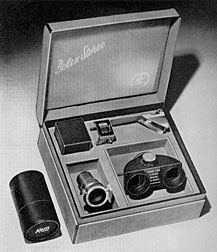 When I graduated from college, my dad and his wife gave me a 16mm Bolex camera from the 1950s. It was a neat gift, but the really unique thing about it was the Stereo Kit that came with it. It was a complete set of stereo lens, projector lens with polarizing filters, and a small silver projection screen. The system works by putting two tall, skinny images side by side on each frame of film. Then when it’s projected, they are offset and overlapped with each one polarized differently, just like a fancy new 3-D movie. Rather than being widescreen though, the image is tall and skinny. Unfortunately in the past I haven’t had the time and money available to get the system going.
The major thing missing right now is a 16mm projector that will take the 3-D lens. I can’t quite figure out what kind of projector it even needs to be. And despite being completely obsolete, they’re not always free. In the research I’ve done over the years I’ve heard that the polarizing filters in the projection lens tend to degrade over time. The projection lens definitely looks a little wonky. If that’s the case, then I’m going to have to figure out how to replace the filters. I’ll have to figure out what orientation they go in since they have to match the orientation of the glasses. I have brand-new 3D glasses provided by Coraline, which I’m pretty sure works on the same principle as the Bolex system.
And of course I’ll need to get a 100′ load of 16mm film and run it through the camera. That’s not exactly free either. Being a wind-up Bolex, sync sound isn’t an option (I also don’t have a dual-system projector lying around, or a way to sync it up in the first place) so I’m thinking a series of silent sight-gags involving things flying at the camera. To save money I’m going to shoot reversal, which I haven’t shot since way back in the year 1999. Apparently Kodak stopped making the higher speed color reversal stock, so I’m considering shooting Tri-X 200D B&W reversal. I’m not entirely sure the system will work with color film anyway. That will be an additional experiment I’m sure. A 100 foot roll costs $25. Processing will probably run another $25. Oh, and I guess I’ll need a light meter. It’s also not clear that the camera will run well without repairs. Last time I looked into it I was told it needed about $200 worth of work on it.


Are you interested in selling this system?
No, I want to get it working and make some films with it, not sell it.
The 3D glasses from Coraline are for the RealD system and will not work. The Bolex Stereo kit uses the older linear-polarized glasses whereas RealD uses newer circular-polarized glasses.
However, linear-polarized glasses are widely available online. A Google search for “3D glasses” will return many links like this one: http://www.3dglassesdirect.com/polarized_3d_glasses.html
Hi…..
Kodak makes a color reversal film called 100D:
http://motion.kodak.com/US/en/motion/Products/Production/Color_Reversal_Films/5285/tech5285.htm
Kodak just started offering it in 100′ loads that your Bolex will take:
http://motion.kodak.com/motion/uploadedFiles/QA_MotionPictureCatalog_March9_2009.pdf
I like to buy direct from Kodak (they have a 800 number) because you receive fresh film. But you can probably find film other places.
I have shot some 100D and I like it (liked kodachrome better). I have seen 16mm 3D film shot with your equipment (well, not *yours*, but the Bolex set up). The 3D effect is outstanding. The film I saw was shot in the late 1950s or early 1960s and was shot using Kodachrome II. The 3D effect was awesome!!!!!
Head to your local Goodwill store and find a screen. You will see white ones, and silver (or kinda gray ones). That is the one you want. But worse case, you can project your film on a white wall. Keep checking the goodwill and you will find a screen. The best 3D effect is with the proper screen, but you will be able to see 3D with a normal white screen (but not as pronounced).
I have many 16mm projectors. I will sell you one if you want, but shipping is costly. Keep checking the Goodwill for a projector. I can help you find a lamp for just about any projector you buy., Many of the lenses are standard sizes. Probably, any ‘ol 16mm projector will do. When you do find a projector, head to the store and buy some Lemon Pledge furniture polish. Then take a old cotton T Shirt or some old cotton underwear and spray the cloth (not the projector), then open up the gate and wipe down the entire film path. You will probably find some rollers with a screw in the center. Unscrew them, remove them, clean them, then rub some pledge on them. Every guide, every place the film goes. Remember, every time you project your film you will scratch it. Back in the day, Kodak said you had about 200 projections before the film would be scratched up beyond repair. So don’t just keep running your film for no reason at all.
If you are new to 16mm movie film you might like this free pdf book from Kodak:
http://motion.kodak.com/motion/uploadedFiles/H2_Field%20Guide_9-22-08.pdf
Feel free to drop me some email if you have movie film related questions. Enjoy your equipment.
jack
And like every other person posting here
have you any idea what a unit like this is worth? I acquired one with a Bolex 16mm cam with the stereo lens attached a few years ago for $50 and I’m trying to appraise it. Any feedback is appreciated.
When it comes to projection you could do as our stereo club does and put your filters in front of the projection lens. You will probably have to remove the old filters. I’m assuming they are not a coating on the lens but a drop-in type. You can get polarizing filters for projectors through any one of several 3D stereo dealers online (you can also get the glasses through them as well). The filters are generally notched on one corner so you can orient them properly. Make a frame out of cardboard large enough to accommodate both filters side by side, mount the filters in the frame and then hang or stand them in front of the lens. All that is required is that the light passes through the polarizers. They can be in back of, inside, or in front of the lens.
White glass bead screens tend to scatter the light, ruining the polarization. I do know some people who have painted a wall or canvas with metallic silver acrylic latex paint and and had good luck projecting onto that. If you go that route, either spray it on or be sure to roll or brush the paint in one direction only (vertically) as the paint is ‘directional’ and shows every brush stroke or swipe with the roller. Used silver screens aren’t that hard to find. Craigslist is a good source.
I wish I had one of those Bolexes!!! You’re a lucky man!
Hey there!
It seems like this conversation ended a few years ago, but thought I’d comment. I shoot 3D slides (still photos) using a Stereo Realist, and several years ago for my senior project, I thought it would be fun to try the Bolex lens. I bought one on ebay and, with the help of my film teacher, we were able to get it functioning. Unfortunately, there were many snafus and the resulting film was un-watchable (a big problem was getting images in focus since the lens was fixed focus), but in theory it should have worked. Projection was a major nightmare – the polarizers were deteriorating and we had to try to replace them, but it was almost impossible to get them to line up correctly. Also, the resulting image, because of the way the film splits up the frames, is about the size of a door (extremely long and narrow). It was a fun experiment – one day, I’ll try it again (I still have the lenses). Of course, processing 16mm film is getting harder and more expensive every year (haven’t done any 16mm myself for several years, either stereo or flat).
Wish I had more technical expertise, but I relied strongly upon my film teacher and some very nice gentlemen from the LA 3-D club who I corresponded with by e-mail. They produced a DVD a few years ago of amateur films made by their members, including some shot with the Bolex system. If you wanted to try it, I would get in touch with some of them. A few of their members were using the system when it first came out!
http://la3dclub.com/
Good luck!
kyle Bolex made 2 Projection lens. One of the lenses(type G) was made to fit or go into a Bolex projector. The other was a universal fit lens ( type S ) that had adapter sleeves for different brands of projectors. These sleves screwed on from the back of the lens and shimmed the lens to a larger diameter so that it would fit the cavity of the projector with out too much slop.I use an S1 sleve to fit my Bell&Howell 273 . The projector/lens should be approxmatly 10 ft. from your silver lienticural screen .The takeing lens is set at a universal focus of 10 feet to infinity .Although after 20 ft. there is little depth . Less than 10 ft.will have strong stereo effect . The fancy takeing lens (stereo closeup devise ) is a rotateable closeup prisms setup that could do normal and closeups. Closeups lens fall into three ranges ,white dot is normal 4ft to 20 ft. , blue dot 28 in.to 7 ft. ,and black dot 18 in. to 34 in. normal use film is shot at 10 ft., ,40 in. , or 24 in. Also never run the projector lamp through the stereo lens without film , or the polorisors could be damaged. Check your camera, if it is a Bolex see if it has a filter holder behind the lens seat. if it does you will have to ream the hole bigger in the filter so the stereo lens can seat properly. Youu can damage the lens by just running it down. check first. Try http://www.bolexcollector.com/
The Bolex system is still a good, high-quality rig, even in these days. Regarding your questions: (1) Any 16mm reversall film will work, and color is especially good. Although Kodak doesn’t make reversal film, they still make professional-grade negative film (System 3, I believe it’s called) and you can get various local film labs to process it and make a positive print. Try CineLabs in New Bedford, Massachusetts for one).. (2) On your question about polarization, these fileters seem to hold up quite well, especially if the lens has not had a lot of light run through it and it’s stored in the dark in it’s case.
Also, the polarization of the ’50’s was “linear”, meaning the polarizing lines are very, very fine parallel (and you don’t really see them) so that a filter with the polarization in the same axis passes light, whereas a filter with the axis at 90-degrees to the first one will block all light. So that’s how the system works: two polarizing linear polarizers, set at 45-degrees to the vertical (meaning 90-degrees from each other). You MUST project the image on a silvered screen (common, white beaded screens will NOT work) and you must have matching lineaar polarizers to see the combined image properly.
The polarizing system in use at theaters and home video today is made differently, and is not compatible with the earlier system. The new rig uses a combination of linear polarizers and aa quarter-wave diffuser which results in what’s called “circular” polarization. Apparently, this is the only way to get polarizing in a TV system, and is also more comforable to use as you don’t have to be so careful as to hold your head straight up during a movie. In the older system, if you tipped your head a bit to one side, you’d start to see part of the opposite image (“ghosting” and the 3-D effect would be lost. Circular polarizars are not dependent on sitting up straight, although if you do tip you head with the circular glasses on, and even though the 3-D image will remain intact, your brain will tell you something’s wrong. This is due to the difference between what the screen is doing (side-by-side images) versus some angle your head is tipped, and the result will be a bit of dizziness. Reasonable posture is all that’s required.
However, for the Bolex system, we’re back to the linerar polarizers, a silver screen, and good posture. You can buy linear polarizers on-line, so that’s not a problem. There were two variations on the Bolex projection lens, and judging by your photo, you have the one that was intended primarily for a Bolex souind projector. Not to worry – that, too, is often found on e-bay.. the other version of the projection lens, meant for other projectors (Bell & Howell, etc) was very much the same optially, but the barrel was different, and also has two small knobs on the front to adjust focusing and, very importantly, side-by-side height adjustment. In stereo projection, it’s ABSOLUTELY CRITICAL that the imagess be at the same height on the screen. If one image is higher than the other, you will have eystrain, headhaches and maybe even nausea. That was one of the problems inthe ’50’s, when projectionists were not always careful about such adjustments. But if you are careful with the focus and height adjustments, and use good projection technquies on the right kind of screen, you will have an amazing experience…
Hope this helps..
I bought the Bolex 3-D system new and still have it. The 3-D lens had a sleeve that made it usable on my Bell & Howell projector. My projector was a B&H 302 magnetic sound projector that play both optical and magnetic sound. The 3-D lens would work with the sleeve on the earlier B&H projectors like the 202 or 185. Not on the later projectors that they switched to around the 1960s.